

Reading Wrap Up: February
Memoirs / Essays / Debuts / DRCs

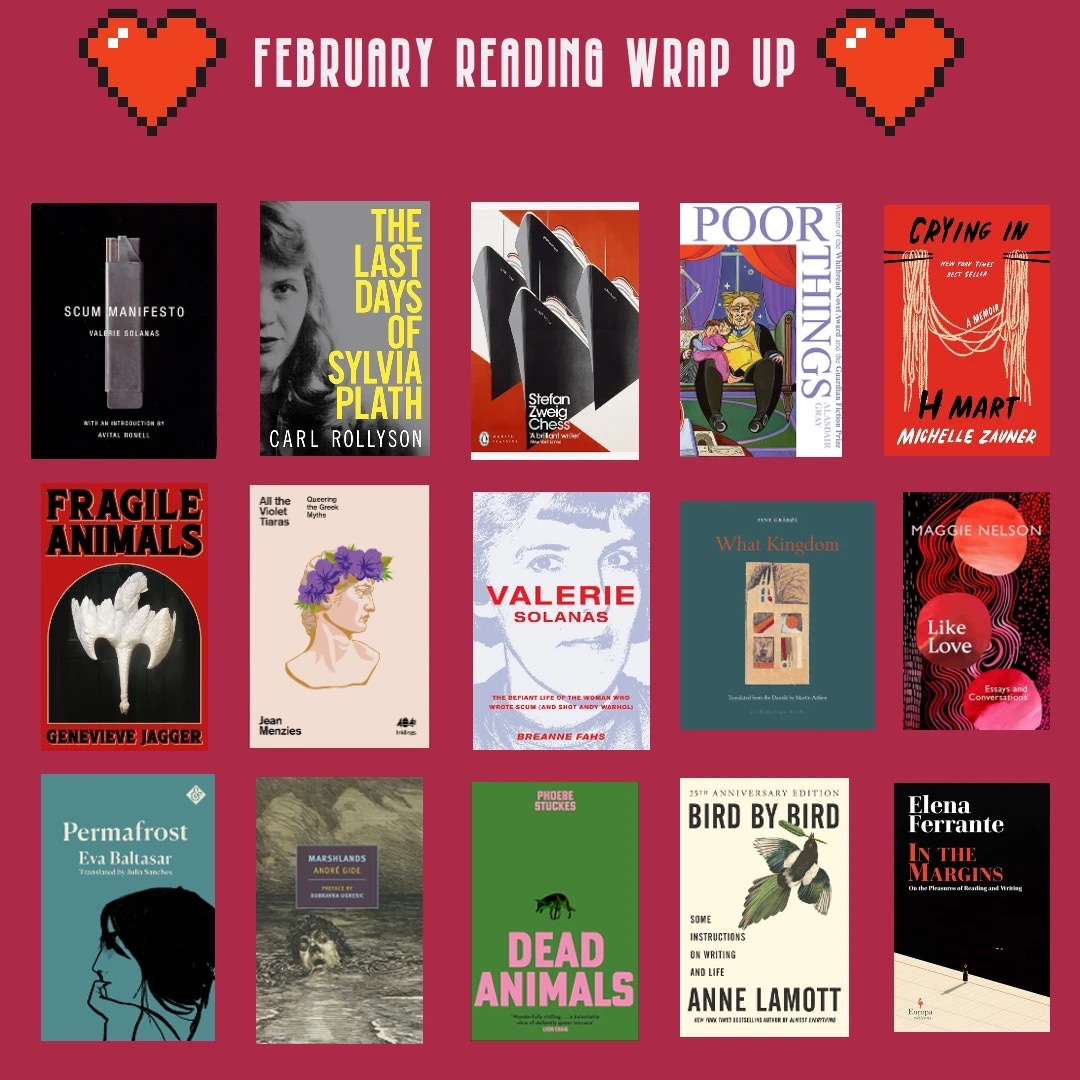
Author’s Note: I have read fifteen books in the month of February, and that is in part due to my purchase of another Kindle. For the sake of newness, I have removed a re-read. At the second-hand bookshop I frequent, he has a sign that reads: Kill the Kindle. However, e-Readers are the most ingenious creations. They enable you to get far more reading done than you would with a paperback. Don’t get me wrong, I own boxes and boxes of physical books, but the e-Reader is one of my most prized possessions. With that said, here is what I read during the month of February.
SCUM Manifesto by Valerie Solanas (4.5 / 5)
Valerie Solanas was the woman who shot Andy Warhol. SCUM Manifesto is her attack on men as a species, and this is shown through quotes like:
“The male is a biological accident: the Y (male) gene is an incomplete X (female) gene, that is, it has an incomplete set of chromosomes. In other words, the male is an incomplete female, a walking abortion, aborted at the gene stage. To be male is to be deficient, emotionally limited; maleness is a deficiency disease and males are emotional cripples.”
The Last Days of Sylvia Plath by Carl Rollyson (4.75 / 5)
I think everyone knows that I am a huge Sylvia Plath stan. Her work was what got me writing poetry. The Last Days of Sylvia Plath does precisely what it says on the tin. Talking us through Plath and Hughes’ fraught relationship, Rollyson reveal some interesting details.
Chess by Stefan Zweig (4 / 5)
This little book packs a real punch. Among chess champions, a game of psychological warfare is afoot. Zweig manages to expertly weave a rich tapestry into so few pages. Without giving too much away, Chess is filled with the game of chess and escaping the Nazis.
Poor Things by Alasdair Gray (4.75 / 5)
I have had this book on my Kindle for a long time, but as the film has debuted, I thought I would finally read it. The story is framed as a found one, with Alasdair Gray acting as the ‘editor’ of papers he found on a friend’s desk. Heavily influenced by Frankenstein, Gray’s Poor Things is an excellent book.
Crying in H-Mart by Michelle Zauner (5 / 5)
This memoir from the lead singer of Japanese Breakfast details her journey with her mother’s cancer. I don’t think I have read a more brutal portrayal of cancer than this one.
Fragile Animals by Genevieve Jagger (5 / 5)
I received a DRC of this from NetGalley. Jagger’s debut is a Gothic story about a woman who meets a man claiming to be a vampire. With poetic prose, Jagger manages to create a cloying atmosphere, and I encourage you to have this one on your radar.
All the Violet Tiaras by Jean Menzies (2 / 5)
Menzies' 'All the Violet Tiaras' suffers from the fust of academia. Unfortunately, there is little personality. For a very short book, the author manages to overwhelm it. While these inkling books are never meant to be comprehensive, Menzies' can only give us a window into nothing more than a classroom full of underappreciated students being forced to listen to the droning of a coffee-breathed professor. There were plenty of opportunities for the author to breathe passion into the text, but that never came.
Valerie Solanas by Breanne Fahs (5 / 5)
This biography of Solanas is so enlightening. Once you read this, you will understand how she came to shoot Warhol.
What Kingdom by Fine Gråbøl (5 / 5)
Translated from Danish by Martin Aitken, What Kindgom is a stream-of-consciousness look into life in a mental institution. Gråbøl offers a searing ritique on the way the government treats the mentally ill, specifically the young.
Our nameless narrator sees life in a unique way. Inanimate objects come to life with phrases such as, “The evening’s bursting, a near-aggressive insistence on light.” This use of personification pulls the reader into the story. Our narrator describes the rain as “applauding, ecstatic,” and such a pathetic fallacy paints a clear picture of how it might feel to be in a psych ward.
Our narrator is pre-occupied with the furniture. She sees them as living lives we can observe, which is something I believe makes sense for someone in that predicament. For her, chairs “address the night,” and this is a vital observation. Our protagonist notices everything. While we never get her name, the reader understands her survival is dependent on discovering herself through these inanimate objects.
Gråbøl creates an atmosphere in a similar vein to Virginia Woolf. While we don’t get to spend much time with the characters, we know just enough about them to form an opinion. Such a cast of characters will naturally blend into each other given the context of setting. A mental institution can be a claustrophobic place.
Additionally, the author uses colour to express the mood of the character. We are shown descriptions such as, “medication-blue” and “egg-yolk yellow”. I felt as though I was spinning on a colour wheel.
Fine Gråbøl takes the senses and brings them the forefront. Just as the characters are suffocated by way of sectioning, the reader is suffocating due to the depth of description the finer details amplify. In Denmark, ONE OF US (an anti-stigma program) has recently emerged, and I believe Fine taking the time to call attention to parts of the text like “to the rest of us” is intentional.
All in all, What Kingdom is a wonderful debut. I understand that Gråbøl is a poet, and I can’t say I am surprised. The beautiful language has not been lost in translation. This book is a modern day classic; one I will return to time and time again.
Like Love: Essays and Conversations by Maggie Nelson (3 / 5)
Thank you to NetGalley for this DRC.
While I am not new to Nelson’s work, this is the first of her books I have read. ‘Like, Love’ is a collection of conversations and essays that discuss a myriad of subjects. From Art Criticism to Bataille, the reader is presented with heavy academic discussions.
This is why I believe this collection could benefit from a bit of direction. It was incredibly dense, and a lot of context is missing. ‘Like, Love’ feels cherry-picked, and while there was a lot to chew on, it could have been separated into sections. I would encourage readers to read this sparingly. For a short book, it felt a 1,000 pages too long.
This is not to say that anyone should dumb down these riveting conversations, but the vital insights get lost in the sheer amount of text contained within it. I understand that Bluets and The Argonauts had some semblance of direction, and this is what I feel this book really needed.
On the other hand, I really enjoyed some of these discussions. They urged me to pick up books I had previously been eyeing up. I also have more films to watch thanks to Nelson. I am a huge fan of Georges Bataille, so to read the discussion about some of his work was fascinating.
Additionally, the title essay was like brain food. The incorporation of various philosophers amplified points, and added a different lens to what could often be a biased view.
Concluding, I am more likely to recommend Nelson’s other works than this one, but this book is for anyone who is interested in enriching their knowledge. You will come out of this collection having learned something new.
Permafrost by Eva Baltasar (4.25 / 5)
Baltasar is a poet, and that certainly shines through this extraordinary novella. I cannot wait for the new Baltasar coming out this August!
Marshlands by Andre Gide (4 / 5)
This is a satirical take on the life of a writer. Gide takes on the conversations surrounding productivity and comparison. This philosophical parody is one you will return to!
Dead Animals by Phoebe Stuckes (2 / 5)
Thank you to NetGalley for this DRC.
Stuckes' premise, on the surface, is structurally sound. The cover adds to the intrigue presented by the description. We follow an unreliable narrator through her unusual life. At times, we aren't sure if we are being told everything.
However, the story as a whole fell flat for me. The characters were so two-dimensional that I found it difficult to care about them. Stuckes' writing reads as more Young Adult than the Adult book advertised. Additionally, there were far too many comma splices, making the book feel slightly amateurish. Many of the sentences could have been rewritten to become beautifully striking.
When the character was expressing her thoughts, they would often be in italics, but Stuckes has chosen to include "I thought to myself," making the sentence thoroughly redundant. This book needs to be gone over with an editor to shape up the technical aspects. Furthermore, we begin the book in second person, which comes across as a mistake for we then end up in first-person perspective for the rest of the novel.
On the other hand, there were some rare gems in sentences such as, "Customers are a screaming hydra of need." Though this isn't enough to save the book for me, and that is why I have rated it as low as I have. I understand what the author was trying to achieve, but it did not land. If this book had been a short story, it could have been spectacular.
Bird by Bird by Anne Lamott (3.75 / 5)
While there were some questionable points, Lamott’s ‘Bird by Bird’ shows the neurotic side of a writer. I have had moments where I have buried my head in the covers because of yet another rejection.
While none of the advice is particularly groundbreaking, I found the personal anecdotes refreshing—finding that they add to the overall narrative. This book is likely more beneficial to people who are new to writing/publishing.
Overall, this was an entertaining read. I empathise with Lamott on the struggles of being a writer.