


Author’s Note: The Poetry Postmortem is where I take a poem I or someone else wrote and I discuss it in a non-workshop way. I am of the opinion that academics and critics have a tendency to suck the life out of poetry. They talk of “critical eyes”, but they are blind to the heart of a poem.
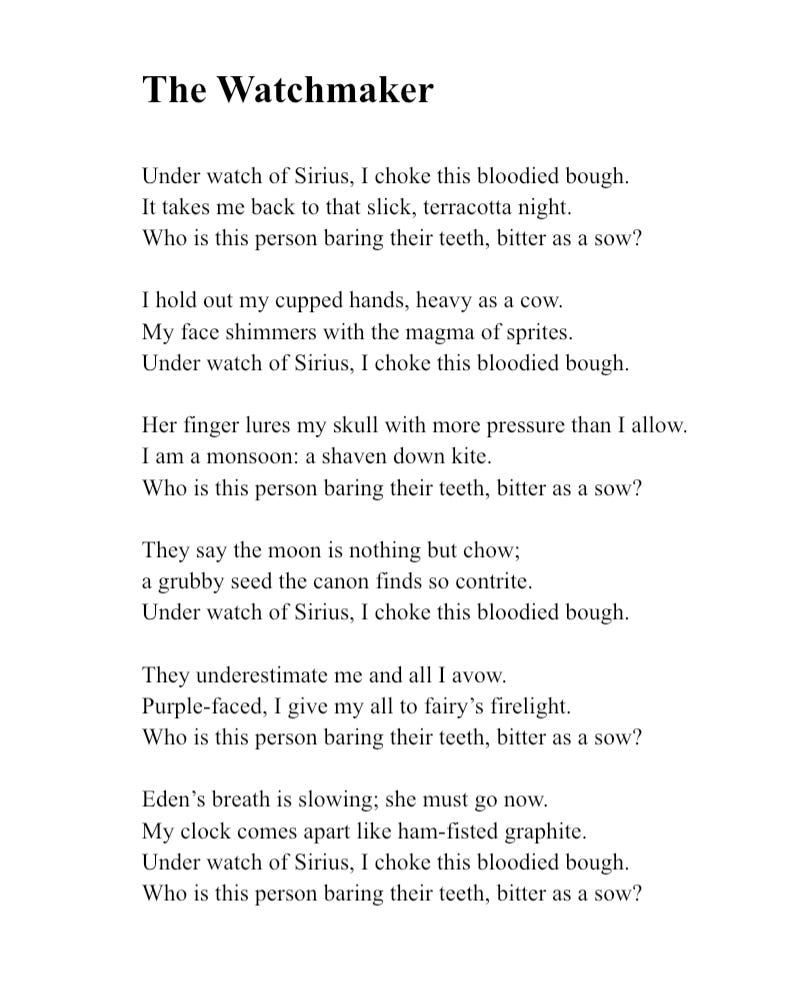
Under watch of Sirius, I choke this bloodied bough.
It takes me back to that slick, terracotta night.
Who is this person baring their teeth, bitter as a sow?
I hold out my cupped hands, heavy as a cow.
My face shimmers with the magma of sprites.
Under watch of Sirius, I choke this bloodied bough.
Her finger lures my skull with more pressure than I allow.
I am a monsoon: a shaven down kite.
Who is this person baring their teeth, bitter as a sow?
They say the moon is nothing but chow; a grubby seed the canon finds so contrite.
Under watch of Sirius, I choke this bloodied bough.
They underestimate me and all I avow.
Purple-faced, I give my all to fairy’s firelight.
Who is this person baring their teeth, bitter as a sow?
Eden’s breath is slowing; she must go now.
My clock comes apart like ham-fisted graphite.
Under watch of Sirius, I choke this bloodied bough.
Who is this person baring their teeth, bitter as a sow?
My first encounter with the Villanelle form came with Sylvia Plath’s Mad Girl’s Love Song. For as long as I have been writing poetry, I have been against restrictive form. I am a bit of an anti-authority, so anything that feels like it stifles my freedom is what I will fight.
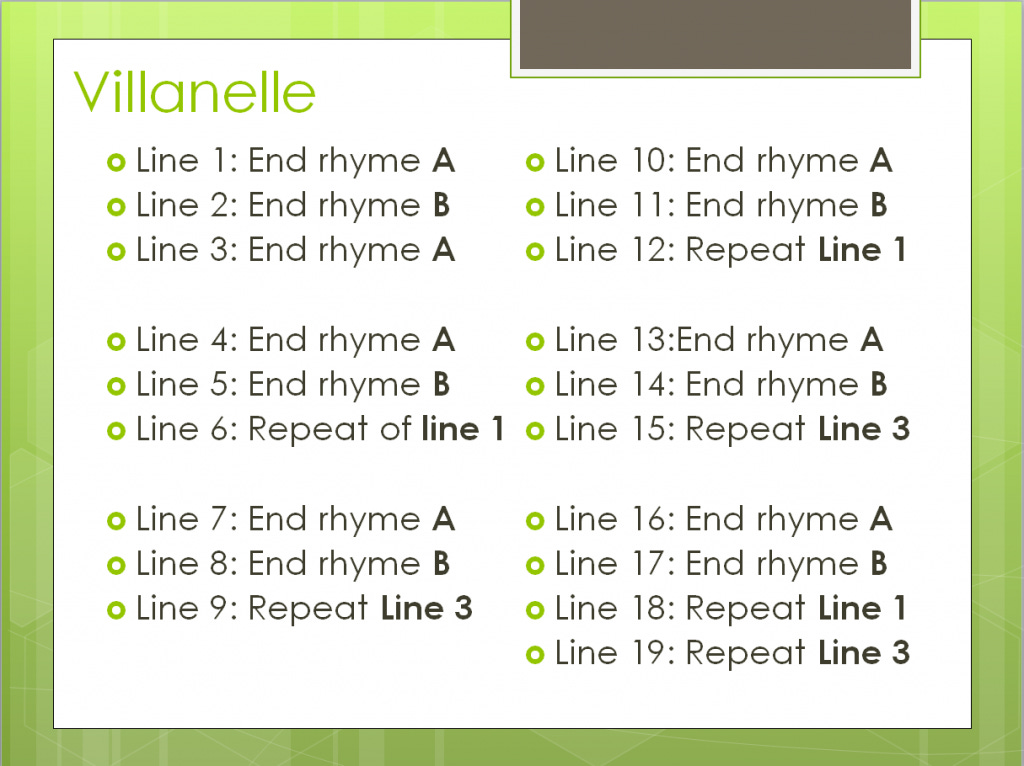
I start out by writing the letters corresponding to the rhyme scheme in the document. This provides me with a neutrality that I can work from. It eradicates the workload so that I can focus on the lines themselves. Writing a Villanelle takes more thought than any other because you have two lines that will be repeated, so you want to make sure you are happy with those first before anything else.
There is no editing with me. I am an organic poet who believes in instinct and knowing what is true. Once I get in the swing of it, the lines will stay. The only difficult thing is finding end rhymes, but there are lots of online resources to help.
With this poem, I veered towards the foreboding. If you know me, you know I love the Gothic. I also bring in the cosmic with the use of Sirius, which is the Dog Star. The moon also features, and that is a given for a poet.
If this were a stuffy classroom or workshop, there would be some arbiter of knowledge asking why I wrote what I wrote. The truth is that most poets don’t truly know what they mean when they write a poem. The words are born from feelings, and plenty of poets will (wrongly, in my opinion) then cut words as a way to ‘refine’ them, but what they are doing is curating their own emotions. If you get angry about something, you don’t become a funnel and beautify your fury, do you?
One of my favourite lines from this poem is: “My face shimmers with the magma of sprites.” It exudes myth and magic in a way that gives light to the darker elements of the poem. When I look back at this Villanelle, I can see that I am perhaps talking about my quest for greatness: my need to be somebody in life.
The line, “I am a monsoon: a shaven down kite” shows this juxtaposition I find within myself. The gentility I was born with is often overshadowed with the fierce drive that came out of being ignored. The opposing metaphors serve to inform the reader of a Gemini’s nature.
One of my repeated lines, “Who is this person baring their teeth, bitter as a sow?”, is a rhetorical question. I think this can be a unique quality for the Villanelle form. It amplifies the uncertainty of the speaker.
The language in this poem is of a classical nature. I would say that the form enhances the erudite nature of the language. Words such as “contrite”, “bloodied”, and “bough” all conjure images of a time passed by.
While the Villanelle form has a lot to offer in terms of poetics, I don’t think it’s quite right for every single poem. There have been times where I planned to write in the form, but I come to discover the words breaking out of their chains. Writing poetry is based on instinct, so go with your gut.